Illuminating the Jungle: The Ultimate Guide to Indoor Plant Lighting and Photosynthesis

Introduction: Why Light is the Lifeblood of Your Home Jungle
Lighting is perhaps the most misunderstood element of indoor gardening, yet it is undeniably the primary engine of photosynthesis. Many plant enthusiasts struggle not because of a lack of “green thumb” or poor watering habits, but because of a fundamental disconnect with light. They often place light-loving succulents in dim, moody corners or delicate, shade-loving ferns in the scorching afternoon sun.
At Mozafer, we aim to demystify this process. We empower you to become a master of your indoor micro-climate by understanding the subtle nuances of light intensity, quality, and duration. Mastering light isn’t just about survival; it’s about helping your plants reach their full genetic potential.
The Science of Light: Beyond What the Eye Can See
The core philosophy of Mozafer is to bridge the gap between nature’s rigid biological requirements and modern home aesthetics. To the human eye, a room might look “bright,” but to a plant, that same light might be insufficient for growth. Light is not uniform; its energy drops significantly as you move just a few feet away from a window.
Understanding the Inverse Square Law of light is crucial: if you double the distance between a plant and its light source, the light intensity doesn’t just halve it drops to one-fourth. Mastering this allows you to create a thriving sanctuary rather than a collection of plants that are merely “clinging to life.” To truly optimize your space, you must learn to “read” the light through the lens of biology.
Understanding Window Orientations: The Natural Compass
Not all windows are created equal. The direction your windows face determines the “menu” of light available to your plants:
- South-Facing Windows (The Sun Trap): These provide the most intense, direct sunlight. They are the holy grail for cacti, succulents, and Mediterranean herbs. However, during peak summer, the heat can become a liability, requiring sheer curtains to prevent leaf scorch.
- North-Facing Windows (The Soft Glow): These offer consistent but low-intensity light. They are perfect for “low-light” champions like Snake Plants, Pothos, and ZZ plants.
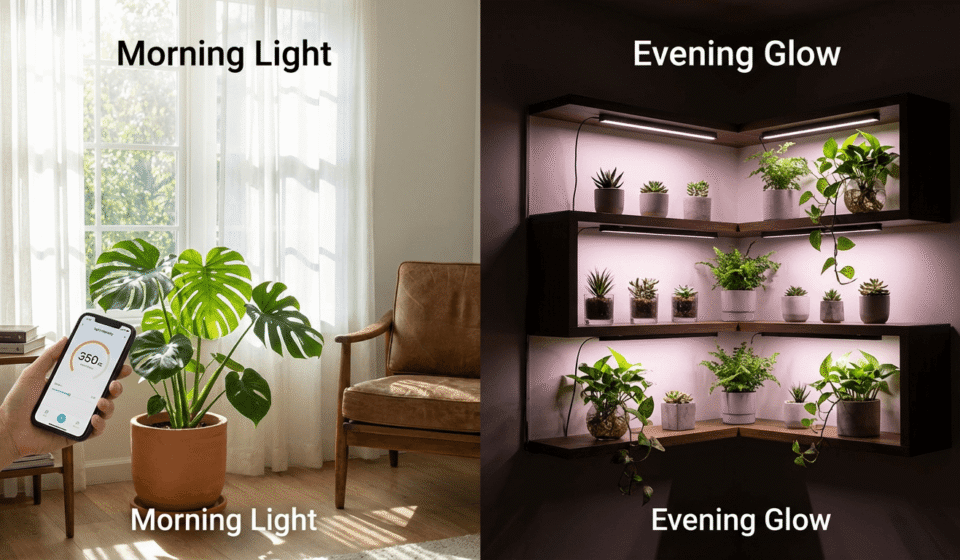
- East-Facing Windows (The Morning Refresh): Offering gentle morning sun and cool afternoons, these are ideal for many tropical plants that enjoy bright, indirect light without the midday heat.
- West-Facing Windows (The Afternoon Heat): These provide intense light in the hottest part of the day. Plants here need to be robust enough to handle the sudden temperature spike.
Artificial Intelligence for Plants: The Rise of LED Grow Lights
If your apartment lacks large windows or faces a dark alley, do not despair. Specialized LED grow lights have become a game-changer in the industry. Unlike old-fashioned bulbs that wasted energy as heat, modern LEDs provide a “full spectrum” of light—mimicking the sun’s blue and red peaks that trigger vegetative growth and flowering.
At Mozafer, we recommend investing in high-quality LED setups that integrate seamlessly with your interior design. Modern grow lights no longer look like purple laboratory equipment; they come in sleek, aesthetic designs that enhance your living room’s ambiance while feeding your plants the photons they crave.
Signs Your Lighting is Failing: Reading Your Plant’s Language
To successfully transition to a master gardener, observing your plants’ “body language” is vital. Your plants will tell you if they are unhappy long before they die:
- Etiolation (Stretching): If your plant is growing tall, thin, and “leggy,” it is literally reaching out for more light.
- Leaf Drop: Sudden loss of lower leaves often indicates the plant is shedding parts it can no longer support due to low energy (light).
- Fading Variegation: If your beautiful white-and-green variegated Monstera starts turning solid green, it’s producing more chlorophyll to compensate for low light.
- Sunscorch: Brown, crispy patches in the center of a leaf usually mean the light is too intense.
Engineering an Aesthetic Ecosystem
While it may be tempting to buy the cheapest lighting equipment available, investing in high-quality sensors and bulbs prevents weak, stunted growth and long-term health issues. By mastering indoor lighting, you are not just caring for plants; you are engineering a thriving, aesthetic indoor ecosystem.
Using smart timers to automate your lighting cycles (ensuring a consistent 12-14 hours of “daylight”) can take the guesswork out of the equation. This consistency is what separates a “lucky” gardener from a professional one.
Frequently Asked Questions (FAQ)
Q1: Can normal household LED bulbs help plants grow? While better than nothing, standard bulbs lack the specific intensity and spectrum (PAR – Photosynthetically Active Radiation) that plants need for robust growth.
Q2: How many hours of light do indoor plants need? Most tropical indoor plants thrive on 10 to 14 hours of bright light. Even plants need a “rest period” (darkness) to complete their metabolic cycles.
Q3: Does dust on leaves affect lighting? Yes! A thick layer of dust can block up to 20% of the light reaching the leaf’s surface. Regularly wiping leaves with a damp cloth is a simple way to boost light absorption.
Conclusion: Effortless Green Living
At Mozafer, we are committed to making green living effortless and sustainable. By aligning your home’s lighting with the biological needs of your botanical collection, you ensure a vibrant, healthy home. Remember, every smart step you take toward better lighting is a step toward a more beautiful and sustainable life.